

Try Weglot for free


Machine translation software is a program that automatically translates text or speech between languages using AI, primarily neural machine translation (NMT).
Businesses now have a credible alternative to hiring a human translator: using machine translation software. These AI-powered tools provide automated translations between languages – such as English to Spanish or Japanese to French – and decades of technological improvement mean they now do a remarkably accurate job.
As a result, machine translation (MT) software is often integrated into computer-assisted translation (CAT) tools and used by businesses involved in international projects. It can translate websites, documents, and customer-facing content at scale – tasks that would take human translators days or weeks.
The financial upside is clear: According to a survey by Common Sense Advisory (now known as CSA Research), Fortune 500 businesses that spent more on translation were 1.5 times more likely to report an increase in total revenue.
Below, we compare the top machine translation software options, highlight their strengths and limitations, and explain how to choose the right tool for your business. For a deeper dive into the fundamentals, see our guide to what machine translation is and how it works.
Note: Looking for a tool to translate your website? Try Weglot's 14-day free trial and see how you can use AI website translation to instantly launch a multilingual site.
There is no single machine translation tool that suits every use case. Each has different strengths across language coverage, pricing, customization, and integration options. Here are the seven leading options, with a comparison table at the end to help you decide.
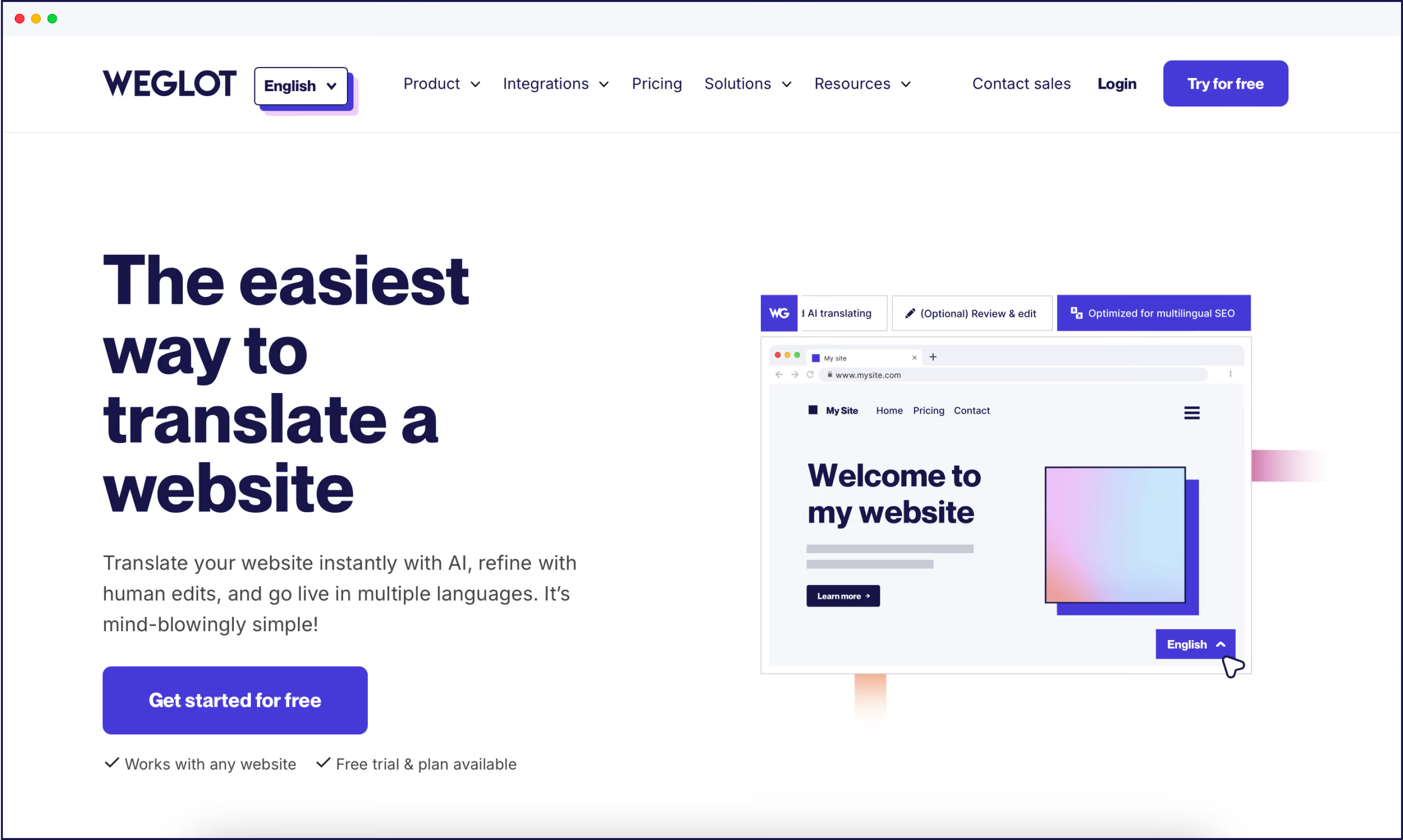
Best for: Businesses that need to quickly translate and display their full website without technical expertise.
Weglot is a website translation tool that uses leading MT engines – including DeepL, Google Translate, and Microsoft Translator – alongside its own AI Language Model powered by OpenAI and Gemini. Rather than being a standalone translation engine, Weglot handles the entire website translation workflow: automatic content detection, translation, display, SEO optimization, and team collaboration – all from one dashboard. As such, Weglot is one example of website translation software that pairs machine translation with on-page editing and multilingual SEO.

Weglot integrates with WordPress, Shopify, Webflow, and all other popular website platforms (and custom-built websites) to translate your website content and display these translations on your website, giving you the full package when it comes to website translation.
It is also built for team collaboration among your teammates and professional translators, making it convenient for you to get expert eyes and edits on your translations before rolling them out.
Pros:
Cons:
Trial and pricing: Weglot offers a free plan (2,000 words, 1 language) and a 14-day free trial on paid plans. Pricing starts at €15/month.
Data privacy: Weglot processes translations through its own infrastructure and complies with GDPR requirements. Translation data is not used to train third-party models.
User rating: 4.8/5 stars

Best for: Quick, free translations across the widest range of languages.
Google Translate needs no introduction, being probably the most well-known machine translation software out there.
Launched in 2006, and currently supporting 249 languages, the translation tool previously used SMT to churn out word-for-word translations.
Since then, however, Google has abandoned SMT in favor of the more accurate NMT, resulting in ever-improving translation quality. Dubbed Google Neural Machine Translation (GNMT), Google’s proprietary machine translation technology uses recurrent neural networks to translate entire sentences while retaining their contexts as much as possible.
Google Translate will also soon offer more contextual translation options. So if you’re looking for a place to park your car or you’re hoping to take a walk in the nearest park, the platform will give you the context you need to use the right words and not get lost in translation. The first languages to feature this include English, French, German, Japanese, and Spanish.
Pros:
Cons:
Trial and pricing: The Google Translate website and app are free. The Cloud Translation API charges $20 per million characters, with the first 500,000 characters free each month.
Data privacy: Text submitted through the free Google Translate interface may be used by Google to improve its services. The paid Cloud Translation API provides enterprise data handling, but businesses should review Google’s data usage policies carefully before translating sensitive content.
User rating: 4.5/5 stars

Best for: High-accuracy translations in European language pairs and professional content.
DeepL Translator is an NMT service developed by Linguee GmbH (now known as DeepL GmbH), a German business that focuses on developing machine translation technology through deep learning.
DeepL Translator was launched in 2017 and currently offers 84 languages. It extensively studies and learns the best translation options from reliable linguistic sources.
Thanks to its use of artificial intelligence, DeepL Translator can deliver more precise and nuanced translations compared to its peers. It may truly live up to its own claim of being “the world’s most accurate translator.”
In January 2024, DeepL added Arabic—the first language it’s supporting that’s written right-to-left—which is currently available on the web translator, along with the desktop and mobile apps. As the 5th most spoken language in the world, businesses can finally cater to more than 400 million Arabic speakers using DeepL’s service.
Pros:
Cons:
Trial and pricing: DeepL offers a free tier (limited to 500,000 characters/month via API). DeepL Pro starts at $8.74/month (Starter plan). Enterprise plans are available for teams.
Data privacy: DeepL is headquartered in Germany and complies with EU GDPR requirements. Pro and API Pro subscribers’ texts are deleted immediately after translation and are not used for training. This makes DeepL a strong choice for businesses with strict data privacy requirements.
User rating: 4.8/5 stars
Best for: Enterprise teams already using Microsoft products, and organizations needing HIPAA-compliant translation.
Microsoft Translator is built on Microsoft’s proprietary NMT system and currently supports 180 languages. It relies on the latest NMT technology to offer accurate translation.
Like most machine translation software developers, Microsoft has focused its research efforts on delivering smarter machine translations that match natural language use. For example, Bing Microsoft Translator employs an attention algorithm to analyze the order in which words should be translated for the most accurate translation results.
In 2023, Microsoft upgraded its Custom Translator platform, where its team of experts have developed a new set of algorithms and techniques to improve the accuracy of the Custom Translator.
It has also integrated with Cortana, supporting languages including Simplified Chinese, German, English, French, Spanish, Italian, Japanese, and Portuguese.
Advanced offline translation is also now available through Microsoft Translator, allowing users to download offline language packs so they can continue using the platform even when they don’t have a steady Internet connection.
Pros:
Cons:
Trial and pricing: Microsoft Translator offers a free tier of 2 million characters per month through Azure Cognitive Services. Paid usage is charged at $10 per million characters. Custom Translator (domain-specific training) is available on paid tiers.
Data privacy: Microsoft offers HIPAA-compliant translation through Azure, making it a strong option for healthcare and regulated industries. Enterprise customers can configure data residency and opt out of data collection for service improvement.
User rating: 3.7/5 stars

Best for: Enterprise and government organizations needing on-premise deployment and domain-specific customization.
SYSTRAN has a long history. It was founded in 1968 and is possibly the first-ever business to offer commercial machine translation services.
And this pioneer in the field hasn’t rested on its laurels: this machine translation provider regularly updates its SYSTRAN Translate tool with cutting-edge machine translation technology and features. For example, SYSTRAN’s latest pure neural machine translation (PNMT) engine models the entire machine translation process through an artificial neural network for highly accurate translations.
It currently supports 55 languages and has 140 combinations.
Pros:
Cons:
Trial and pricing: SYSTRAN offers a free online translator for basic use. Paid plans start at $18.99/month per user (billed annually) or $25.99/month (billed monthly). Enterprise and on-premise pricing is quote-based.
Data privacy: SYSTRAN offers on-premise installation, meaning all translation data stays within the organization’s own infrastructure. This makes it one of the most privacy-conscious options available, particularly for defense and government clients.
User rating: 4.7/5 stars

Best for: Developers and AWS-native teams needing scalable, API-driven translation for applications and content pipelines.
For those in the know, Amazon isn’t merely a leading ecommerce marketplace: it also supplies machine translation through its Amazon Translate tool.
According to the Amazon Translate website, this NMT service was created to provide fast, high-quality, and customizable language translations at an affordable price.
Amazon constantly enhances its datasets to deliver the best possible translations regardless of source text length. At the same time, Amazon Translate’s Active Custom Translation feature allows users to import their own translation data for customizing translations according to their preferences.
The provider currently supports 75 languages.
Pros:
Cons:
Trial and pricing: Amazon Translate is pay-as-you-go based on the number of characters translated per month (including whitespace). Free tier: 2 million characters/month for the first 12 months after signup. After that, pricing is usage-based – use the AWS Pricing Calculator to estimate costs.
Data privacy: Amazon Translate processes content through AWS infrastructure. By default, translated content may be used to improve the service, but customers can opt out via an AWS support request. Enterprise customers can leverage AWS’s compliance certifications (SOC, ISO, PCI) for regulated workloads.
User rating: 3.5/5 stars
Best for: Translation agencies and CAT tool users who want an adaptive MT engine that learns from their corrections in real time.
ModernMT is an adaptive neural machine translation engine designed for professional translators and language service providers. Unlike static MT engines, ModernMT learns from every post-edit a translator makes, continuously improving its suggestions for that specific project and domain.
ModernMT supports 200 unique language pairs (up to 40,000 language combinations) and integrates with RWS Trados, Matecat, and MemoQ via plugins for the LSPs/CAT tool plans.
Pros:
Cons:
Trial and pricing: ModernMT offers two pricing tracks. API for enterprises: "Human in the Loop" (from $15/M chars, accuracy up to 99%, human corrections included) and "Adaptive" (from $15/M chars, accuracy up to 95%). LSPs and CAT tool plugins: "Individual Translator" ($25/month, 150,000 words/month, individual license) and "Localization Teams" ($100/month, unlimited words and translators). All plans include a free month trial.
Data privacy: ModernMT provides full content ownership with no data sharing across accounts.
User rating: None as of the time of writing
Out of all of the solutions we’ve discussed, Weglot stands out by offering a complete website translation solution that combines the best machine translation engines with direct platform integration, meaning it not only translates content but also handles the technical implementation and display of translations on your website.
Unlike standalone machine translation software, it provides an end-to-end solution with team collaboration features and post-editing capabilities, eliminating the need for manual copy-pasting or technical expertise in implementing translations.
That said, the "best" tool depends on your use case. The comparison table below can help you decide.
Different translation scenarios call for different tools. Here is how to match your needs to the right solution:
The key distinction is between a standalone translation engine and a translation platform. Engines like DeepL, Google Translate, and Amazon Translate handle raw text translation. Platforms like Weglot add layers on top – website integration, team collaboration, SEO handling, and visual editing – making them the better choice when the goal is translating an entire website rather than individual text blocks.
Looking for a broader overview that includes AI-powered writing and translation tools beyond MT engines? See our comparison of the best AI translation tools.
Machine translation software has evolved tremendously, moving from rudimentary rule-based systems to sophisticated neural machine translation models. This leap in technology makes it an invaluable tool for businesses looking to scale internationally, both efficiently and affordably.
Weglot offers an integrated, high-quality translation service that combines the best machine translation software, such as DeepL, Microsoft Translator, and Google Translate. With easy installation and team collaboration features, Weglot simplifies website translation without compromising on quality.
With its unique mix of the authority of professional translation and the speed and reliability of machine translation, all simple to manage through your Weglot Dashboard, you’re sure to provide a high-quality localization service and enhance your customer experience with Weglot’s online translation platform.
Sign up for a 14-day free trial (no-commitment) of Weglot to get started.

We’ll get your first languages live. You decide how far you want to go. Try Weglot for free today.
Trusted by 70,000+ global brands





Weglot is tested and trusted by brands worldwide since 2016. Join them today.


The best way to understand the power of Weglot is to see it for yourself. Test it for free and without any engagement.
A demo website is available in your dashboard if you’re not ready to connect your website yet.


No. Machine translation has been proven to be highly accurate in recent studies. Couple machine translation with Weglot’s AI Translation Model, and your translations become even more human-like and in keeping with your brand voice.
By creating your own custom translation model within your Weglot Dashboard, it learns from your style guidelines, glossaries, and any custom rules to implement your brand voice across your translated website content.
Machine translation, when managed by a tool like Weglot, is a positive for SEO, provided the technical and content foundations are solid.
With Weglot, all the technical aspects of ranking internationally are automatically implemented. Including hreflang tags, language URLs such as subdirectories or subdomains, translated metadata, and the option to translate URLs.
If you want to go further in your multilingual SEO strategy, you can also look into researching the correct keywords for the market you’re targeting.
But overall, the crucial point is the technical implementation. A dedicated website translation tool automates the SEO-critical steps (like hreflang and URL structure) and gives you the tools to refine the translated content for local keyword optimization.
Yes, this is the single biggest advantage of using a machine (AI-powered) translation tool.
Integration is key to efficiency, and modern solutions are built for seamless compatibility.
A tool like Weglot is designed to be CMS-agnostic and integrates easily with major systems:
There are four main types.
For a deeper dive, see our guide to what machine translation is.
Over 56% of consumers say information in their own language matters more than price – yet most websites only serve content in English. Machine translation software closes that gap at a fraction of what human translators cost, translating entire websites or document libraries in seconds rather than days. That speed and affordability is why even professional translators now use MT as a starting point, layering human editing on top. For businesses translating websites specifically, platforms like Weglot go further by handling multilingual SEO, content detection, and display alongside the translation itself. See our guide to website translation costs for a detailed breakdown.
ChatGPT is a large language model (LLM) that generates text by predicting the next word in a sequence – it is not a dedicated machine translation tool. While it can translate text between languages, it was not trained specifically on parallel language pairs the way NMT engines like DeepL or Google Translate are.
This means ChatGPT can handle casual or creative translation tasks well, but it may be less consistent than purpose-built MT software for high-volume or technical translation. For website translation at scale, a dedicated MT-powered platform like Weglot is a more reliable choice.
Neural machine translation (NMT) is trained specifically on parallel language pairs – matching sentences in one language to their translations in another – which makes it highly efficient and accurate for translation tasks.
Large language models (LLMs) are trained on general multilingual data and generate translations by understanding context across languages more broadly.
NMT excels at speed, consistency, and cost efficiency for high-volume translation. LLMs can add richer contextual understanding, which is why some platforms now combine both approaches – using NMT for speed and LLMs for nuance.
A standalone translation engine (like Google Translate, DeepL, or Amazon Translate) handles raw text translation: You input text in one language and receive it in another. A translation platform (like Weglot, Lokalise, or Smartling) adds workflow layers on top – such as website integration, CMS connectors, team collaboration, translation memory, visual editing, and SEO handling. If you need to translate individual text blocks, a standalone engine works well. If you need to translate and manage an entire website or application, a platform provides the end-to-end infrastructure.
Several machine translation tools offer free tiers.
Each free tier has limitations: Google's web tool lacks customization, cloud provider free tiers expire or have usage ceilings, and ModernMT's trial is time-limited.
Machine translation has improved dramatically, but it is not a replacement for human judgment in every scenario. Here are the key limitations to be aware of:
The practical solution for most businesses is to use MT for the first-pass translation, then apply human post-editing for quality assurance — a workflow that tools like Weglot support natively through their built-in editing and collaboration features.


